
POPULATION
224 (2001)
186 (2011)
179 (2020)
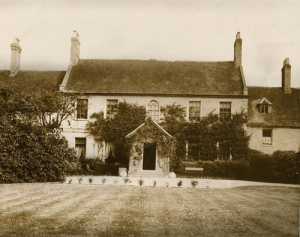
The Old Rectory
The parish of Snailwell covers an area of 2,034 acres (823 ha) in the extension of eastern Cambridgeshire that surrounds the town of Newmarket in Suffolk. The western and southern boundaries also form the border between Cambridgeshire and Suffolk, with the southern boundary following the line of the ancient Icknield Way (now the B1506). The northern boundary with Fordham follows the River Snail that rises in the parish, and the eastern boundary with Chippenham follows field boundaries.
The parish has been occupied since at least the Bronze Age when woodland was cleared. Ten tumuli, discovered in 1879, were situated alongside the Icknield Way but were flattened in 1941 when preparing space for a wartime airfield. RAF Snailwell was open from 1941 until 1946 just north of the railway line towards Bury St Edmunds and housed primarily American Air Force personnel with contingents from the R.A.F., 302 Polish squadron and the Royal Belgian Air Force. Sections of the concrete track and air-raid shelters can still be seen.
Due to its proximity to Newmarket, the village has been heavily involved in the breeding and training of horses since the Jockey Club of Newmarket bought 421 acres (170 ha) in the village for training in around 1882. In around 1900 Snailwell Stud was founded to the south-west of the village and grew to one of the most renowned in the country. Its most famous stallion was Chamossaire (1943–65), and in 1965 a life-size bronze statue of the horse was made by John Skeating to stand where the Newmarket Road reaches the village. Around a third of the land in the parish is now involved in the horse-racing industry.
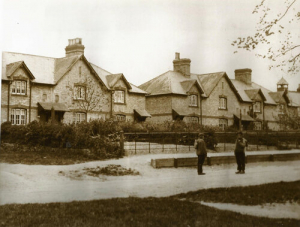
Farm hands outside 24 The Street
Listed as Sneillewelle in around 1050, and Snelleuuelle in the Domesday Book of 1086, the village’s name means “spring or stream infested with snails” or perhaps “sluggish stream”. The spring in question may well be that in the north west of the parish that is the source of the River Snail.
A pub has been recorded in Snailwell since at least 1670. The village’s only remaining pub, The George and Dragon, opened before 1834, moving to its present site in 1842.
The village school closed in 1933: the building served as the village hall until 1976, when it became a private house.
The church of St. Peter is an edifice of flint with stone quoins and windows, consisting of chancel, nave, aisles, south porch and a round western tower of Norman work containing 2 bells: the handsome reredos was presented in 1878 by the late William Montagu Tharp esq. as a memorial to his father; several stained windows being given at the same time by the family of the Rev. J N. Hill, a former rector, by the late William Montagu Tharp esq. and by the members and friends of the family of the late rector: the vestry was also built by the late rector’s family, whose friends defrayed the cost of the mural decorations which cover the whole of the interior: the church was completely restored in 1878-9, and affords 130 sittings: in the churchyard is a stone tomb of a priest of the 15th century, with a cross on the upper slab, discovered in the wall of the south aisle during the restoration. The register dates from the year 1629.